
In this first edition of the new Problem? Solved! RS Expert Advice series, Alex Davies, the Senior Director of Solutions Product and Delivery at RS, explains how value-added solutions and services, like digital integration, kitting, and assembly, reduce manual ordering work, lower total cost of ownership, and simplify supply chain coordination.
RS serves industrial customers engaged in building and maintaining assets and infrastructure throughout the discrete and process manufacturing, facilities and intralogistics, and energy and utilities industries — providing an extensive array of proven product solutions from trusted suppliers as well as a selection of value-added solutions and services designed to solve customers’ pain points. The new “Problem? Solved!” RS Expert Advice series features RS experts addressing a common customer challenge and sharing how RS can help solve it.
For this edition, we spoke to Alex Davies, the Senior Director of Solutions Product and Delivery at RS — who you can learn more about in this RS Experts Behind the Advice Interview — about how value-added solutions and services, like digital integration, kitting, and assembly, reduce manual ordering work, lower total cost of ownership (TCO), and simplify supply chain coordination.

Product and Delivery, RS
Welcome, Alex. You joined us to talk about streamlined procurement. So, please explain how value-added RS solutions and services, like kitting, assembly, and eProcurement integration, reduce manual ordering work, improve part accuracy, and tighten supply chain coordination.
We serve customers of all sizes across the full swath of industrial verticals, from people who build small pieces of machinery to commercial airplanes. Over the years, I’ve seen just about everything get made — food, beverages, electronics, machinery, and even infrastructure that supports power generation and clean water. Typically, the things that we sell to customers in these various verticals create complexity because they are small and low value, purchases are frequent, and there’s a lot of it — think automation and control components, MRO consumables, PPE, and electrical accessories. As such, the amount of activity that it creates is disproportionate to its overall value, which is really problematic for industrial organizations.
The first thing we do to help customers streamline procurement is to actually address that point directly, because you might be surprised at how many businesses underestimate the inherent complexity in managing MRO or production supplies because they’re so focused on cost or just making sure that stuff is available. But the amount of touch required is pretty significant. Having worked with industrial customers for many years, I often see them caught firefighting. It’s not that they lack awareness; they just don’t have the time to step back and address what’s happening. They’re caught in a constant hamster wheel of reactive purchasing and operational urgency. As a result, one of the first and most important things we do when engaging with customers is to ask the kinds of questions that help them hold a mirror up to themselves and recognize that managing massive volumes of MRO and production supplies is really hard.
Digitalization, business spend management platforms, and other procurement technologies
In more recent years, we’ve been seeing a growing trend towards digitalization. We have invested heavily in our core web capabilities, offering customers faster and more intuitive search capabilities and the ability to upload a BOM so they can match their needs to our range very quickly — all of which is helpful. But we’re also seeing a broader shift towards digital integration and total spend management.
Many of our enterprise customers are now investing in either ERP (enterprise resource planning) modules or — even more commonly — software as a service (SAAS) applications, including business spend management platforms, that consolidate all of their legacy purchasing technologies into a singular, curated experience. At the same time, many of these organizations have also grown inorganically, sometimes buying dozens of different companies within their vertical — each with their own technology stack that can quickly become out of date. As such, it’s very hard for these types of enterprise companies to drive a consistent procurement strategy given the constraints that this creates around spend visibility.
To support these customers, we focus on driving integration. We have a mature eProcurement capability in Europe and are now seeing similar momentum in North America. In simple terms, we integrate directly into procurement platforms so that customers can access RS through a dedicated catalog or punch-out experience. When users select RS within their procurement system, they are taken to a curated version of our website tailored to their needs. They can shop the site like normal and then return their basket to their own system, which generates an electronic purchase order without manual intervention. Order acknowledgements, confirmations, and invoices are also transmitted electronically, which provides real-time visibility and reduces administrative effort.
One key benefit of this integration is that it saves customers from having to solicit multiple quotes for routine purchases. There is no need for users to go wandering around with pieces of paper to get approval. Everything becomes digitized. We even send any acknowledgements, confirmations, and invoices back electronically so that they drop directly into the customers’ system and keep them updated on order progress. We didn’t pioneer this technology, but we effectively plug into it and — even more impactfully — help customers better leverage it and further increase the ROI of their investment.
Imagine that you’re the corporate center of procurement for an enterprise-level beverage manufacturer with 50 sites across the U.S., each of which has hundreds of employees involved in procurement, and you’re really trying to drive change, but nobody wants to follow and you get a lot of push back. We have relationships on the ground with engineering and maintenance teams. So, we can directly influence adoption, which can help drive platform compliance and consolidate vendors.
Earlier in my career, I worked with an industrial organization that had more than 12,000 suppliers. While this was in a highly regulated industry, even typical manufacturers often rely on hundreds of suppliers for MRO and production consumables, which creates significant inefficiency.
Historically, industrial procurement decisions were dominated by price and availability. With limited digital tools available, few organizations considered total cost of ownership. Research conducted in the UK in collaboration with the Chartered Institute of Procurement and Supply suggested that for every dollars spent on MRO products, organizations could incur up to two dollars in associated process costs due to fragmented supply bases and high transaction volumes.
Reactive sourcing behaviours can also contribute to supplier proliferation. When an engineer urgently sources a replacement part from an unfamiliar vendor, it can create the perception that the item is only available from that source. Over time, this reinforces the long tail and increases complexity.
Now, we’re seeing more and more industrial customers acknowledging that the world is changing. They’re struggling to attract skilled labor. They’re being asked to do more for less. And they really don’t have time to manage hundreds to thousands of suppliers. As such, the per-item cost pressures of the past are easing, meaning that fewer customers care if a part costs $5 instead of $4.90. Instead, what they care about is the fact that they can get ahold of it quickly and efficiently. Cost is still a major concern, sure, but the focus is now on total cost of ownership, and procurement time, effort, and cost factors into that. So, industrial customers are increasingly adopting digital procurement platforms and consolidating their supply chains, and we’re actively encouraging this trend and integrating into these systems to relieve the massive pain points and excessive costs created by sourcing parts through hundreds to thousands of different suppliers.
RS Custom Order Solutions
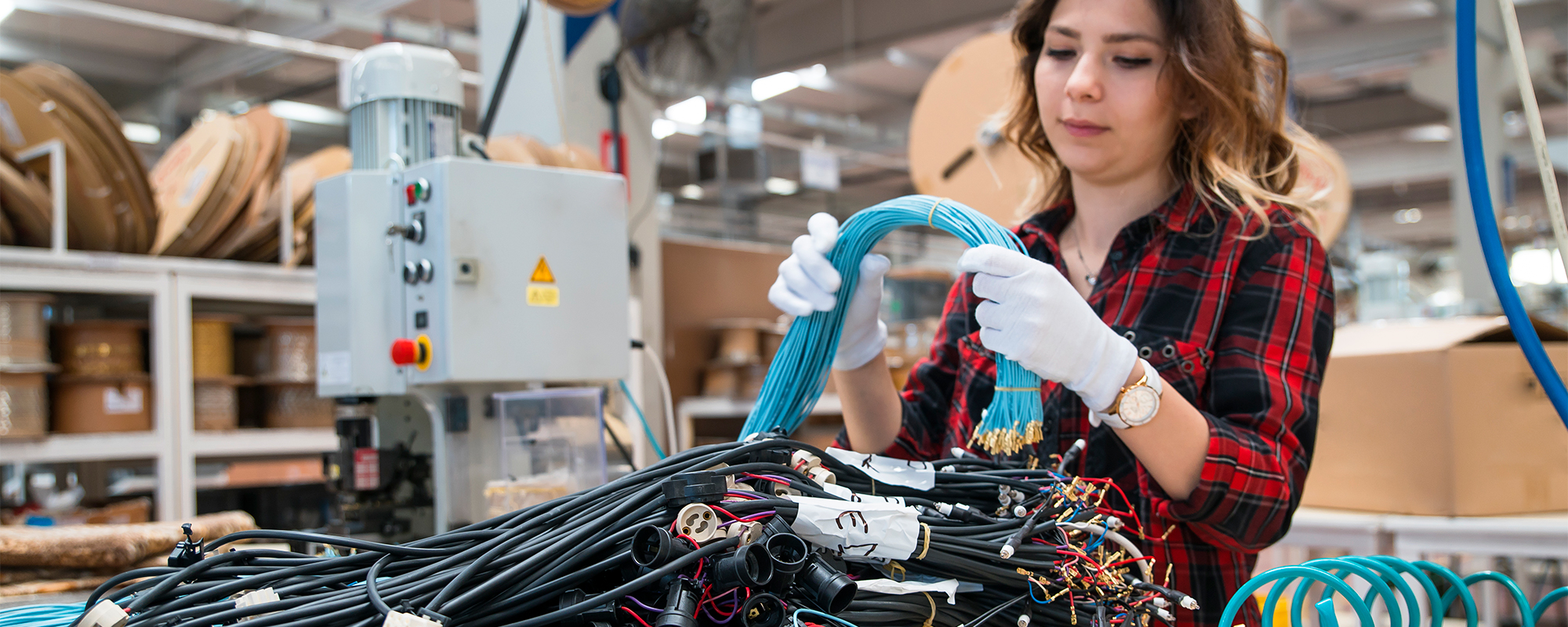
I’d also like to talk about RS Custom Order Solutions, which, in the simplest terms, means that we provide customers with products how they want them when they want them. For example, we can configure multiple items into a kit or a small assembly instead of individual SKUs to help them further accelerate the installation process, which saves time and, as such, money.
I like to think about it like LEGO®. When you buy off-brand building blocks, all the pieces are mixed, so they go everywhere and require a substantial amount of sorting time, and the instructions are often unclear. This is similar to what many industrial customers encounter every day. Before they can begin their assembly process, they have to navigate goods receipting processes, put-away processes, which are often constrained by space, and, later, pick, prep, and stage items ready to be moved to production areas. And since the entire industrial market is suffering from persistent labor shortages, this extra work can end up being disproportionately costly.
By contrast, buying LEGO brand bricks offers a different experience. All of the parts are organized in numbered bags and the instructions are crystal clear, which eases and hastens assembly. Occasionally, they’ll even go ahead and push a little piece of plastic into a hole for you because they recognize that it’s a particularly tricky operation that could cause users to inadvertently damage one of the parts.
So, we aim to be like LEGO. We recognize that our customers are managing a constant flow of deliveries and disparate parts coming into their facility and that they’re short on the resources needed to efficiently organize their stores, repick those same parts, and run them to the right parts of the production line — typically using little steel trolleys that often drop a part or three during the delivery, which further complicates the assembly process. In today’s competitive industrial market, organizations aspire to be faster to market and leaner than ever — and we want to help.
By working together to define kit structures, we can help reduce SKU complexity, lower transaction volumes, and simplify supplier management. When customers also share demand forecasts or order book visibility, we can plan supply more effectively and deliver kits exactly when needed or support flexible call-off arrangements.
Streamline your procurement process with an RS eProcurement integration and RS Custom Order Solutions
If reducing your manual ordering work, lowering your total cost of ownership, and simplifying your supply chain coordination sounds advantageous, reach out to your local RS representative at 1.866.433.5722 or contact the RS Value-Added Solutions Team to learn more about our eProcurement integration and Custom Order Solutions. We support integration with all major procurement platforms, including SAP Ariba, Coupa, and JAGGAER, and our expert business development managers are happy to come talk to you, learn your business, understand your needs, and identify the solutions sure to provide you with maximum value.