

Sven Burkard, Solutions Consultant at Belden, deep dives into IT/OT convergence, discussing the critical role that modular industrial patch panels play in protecting Layer 1 infrastructure, best practices for patch panel selection and implementation, and how Belden’s Modular Industrial Patch Panel (MIPP) family delivers flexible, mission-critical connectivity.

IT/OT convergence is the driving force behind advanced automated manufacturing facilities. Integrating enterprise IT networks with plant floor operational technology (OT) is key to transforming isolated production facilities into responsive, automated assets. But this digital integration requires a massive influx of network cabling and introduces significant operational risks, as a single unmanaged cable tangle or broken fiber strand can quickly bring automated production lines to a halt, and the resulting unplanned downtime can cost operators thousands of dollars per minute.
Industrial patch panels form the critical Layer 1 foundation of this connected architecture, safeguarding delicate structured cabling, organizing crowded control cabinets, and safely transitioning high-speed enterprise networks onto the factory floor.
We spoke with Sven Burkard, Solutions Consultant at Belden, to explore how IT/OT convergence is reshaping factory floors, the critical role that modular industrial patch panels play in protecting Layer 1 infrastructure, best practices for patch panel selection and implementation, and how Belden’s Modular Industrial Patch Panel (MIPP) family delivers flexible, mission-critical connectivity.
Hi Sven. Please introduce yourself and tell us a little about Belden.
Hi, my name is Sven Burkard. I am a Solution Consultant with Belden based out of Richmond, Virginia, and consider myself “legacy Hirschmann,” having joined Hirschmann about 28 years ago — well before its acquisition by Belden. Throughout my career, I’ve held roles in product management, marketing, and now solution consulting, where I effectively perform application engineering work for our sales team. My primary role is to bridge the gap between sales and technical execution, ensuring that our promised networking architectures deliver on customer expectations in the field. I am also supported by a deep technical engineering team for high-level specialized design.
My work primarily focuses on active networking products — passing packets and keeping connections running across virtually every imaginable industrial sector. Belden hardware can be found everywhere from municipal water treatment plants, automotive assembly lines, and semiconductor wafer fabrication facilities to deep-sea blowout preventers on the ocean floor and active networking equipment aboard the International Space Station.
While Belden was originally founded over 120 years ago as a wire and cable manufacturer, the company has transformed into a comprehensive connectivity solutions provider. Through strategic acquisitions — including Hirschmann, Lumberg Automation, ProSoft Technology, Tofino Security, and NetModule — Belden offers a complete portfolio spanning Layer 1 physical cabling up through Layer 2 and Layer 3 managed Ethernet switches, backbone MPLS-TP nodes, industrial firewalls, wireless networking, edge computing, protocol converters, and network management software like Industrial HiVision.
You joined us today to talk about IT/OT convergence and industrial patch panels. So, let’s dive into IT/OT convergence first. What should people know?
IT/OT convergence refers to the integration of information technology (IT) systems, such as cloud platforms, enterprise data, and business software, with operational technology systems, including physical production machinery, PLCs, sensors, and actuators.
Historically, factory floors operated as isolated collections of machinery. IT/OT convergence serves as the central driving force behind Industry 4.0, transforming these isolated plants into responsive, data-driven smart assets that adapt instantly to market demands. Key operational benefits enabled by convergence include predictive maintenance, real-time visibility for smarter decision-making, improved operational efficiency, mass customization and agility, and unified cybersecurity monitoring.
Traditional OT maintenance was reactive or preventative, which led to increased downtime and component costs. IT/OT convergence allows OT sensors to monitor real-time operating parameters, such as vibration, temperature, and cycle counts, while IT analytics and AI models process that data to predict impending failures and display them on HMIs and remote-accessible dashboards. This enables technicians to service equipment before it fails during planned downtime.
IT/OT convergence also integrates IT business software, including enterprise resource planning (ERP), order management systems (OMS), supply chain management (SCM), and warehouse management systems (WMS) software, with factory-floor PLCs, which offers several key advantages. It replaces manual clipboard logs and spreadsheets with real-time operational dashboards detailing output, production costs, and line bottlenecks as they occur. It enables automated just-in-time inventory tracking — allowing, for example, the OT layer to automatically relay raw materials needs to IT business software, which then automatically reorders supplies, reducing both warehousing overhead and data-entry errors. And it allows e-commerce orders entered into OMS and ERP software to automatically route custom production parameters directly to robotic assembly cells on the factory floor, which helps facilities seamlessly switch between product variants without pausing production lines.
Convergence also enables organizations to extend enterprise IT cybersecurity tools, such as automated threat detection, centralized security operations center (SOC) monitoring, and asset management, directly into the plant environment, which is key, as smart advanced automated industrial facilities can’t afford to rely on “security by obscurity.”
What are industrial patch panels, and what role do they play in IT/OT convergence?
Industrial patch panels are ruggedized enclosed connection points designed to organize, manage, and terminate incoming and outgoing network media in harsh environments. Their primary roles within automated industrial architectures include:
- Protecting critical cabling: Permanent infrastructure cabling installed through conduits, walls, and overhead trays is expensive and labor-intensive to replace. Structured cabling terminates securely into the rear of an industrial patch panel and remains fixed. All day-to-day patching, routine testing, and equipment connection take place on the front interface using short, inexpensive patch cords. If a cord is damaged by vibration or accidental pulling, only the patch cord needs replacement, preserving the permanent cable run.
- Improving control cabinet organization: Industrial control cabinets house numerous PLCs, HMIs, drives, and power supplies. Patch panels organize incoming network lines into clean, clearly labeled grids, eliminating unmanaged cable clutter and reducing technician error.
Streamlining troubleshooting: Centralized termination points allow technicians to rapidly attach diagnostic tools and isolate network faults without manually tracing long cable runs across a plant floor.
In the context of IT/OT convergence, industrial patch panels serve as the vital physical bridge between standard enterprise IT network architectures, such as structured fiber and twisted-pair copper, and the physical realities of the plant floor. As facilities shift from legacy serial fieldbuses, such as Modbus or Profibus, toward unified Industrial Ethernet protocols, like PROFINET or EtherNet/IP, the volume of cabinet network cabling increases significantly. Industrial patch panels centralize these media lines while providing the physical mapping required to implement network segmentation, demilitarized zones (DMZs), and industrial firewall zones.
Unlike standard commercial patch panels designed for climate-controlled server rooms, industrial patch panels feature:
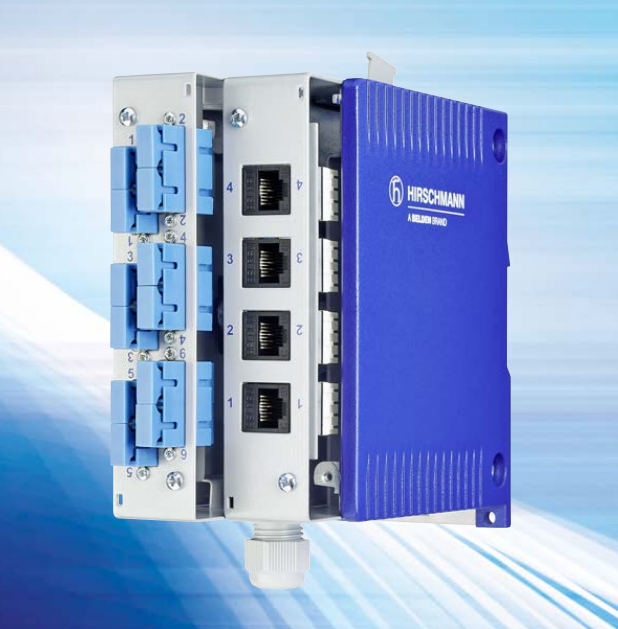
- DIN-rail mounting. Compact units offer footprints that snap directly onto standard 35mm DIN rails alongside PLCs and power supplies.
- EMI/RFI shielding. Metallic housings and grounded shielding protect data integrity against electromagnetic noise generated by heavy motors, variable frequency drives (VFDs), and arc welders.
- Environmental protection. Robust enclosures provide IP20 ratings for inside-cabinet dust protection and IP67+ ratings with screw-locking M12 or bayonet connectors for direct machine mounting exposed to washdowns and oils.
Industrial patch panels are also available in several cabling media and port configurations for broad application suitability. Common media types include copper cable with shielded RJ45 connectors for runs up to 100 meters, fiber optic cable for extended distances, high bandwidth, and complete optical isolation against severe EMI, and hybrid multimedia units that combine copper and fiber in a single footprint. Common port configurations include fixed-port panels for cost-effective permanent port layouts and modular keystone panels that support configurable snap-in jacks, media mixing, and individual port replacement.
What common challenges do people face when it comes to selecting and implementing patch panels, and do you have any advice for overcoming these challenges?
Because patch panels sit at the intersection where delicate data cabling meets rugged operational environments, improper specification or installation can elicit several common challenges and cause issues ranging from signal attenuation and packet drops to costly downtime.
Common selection challenges include:
- Mismatched environmental ratings. Installing standard commercial IP20 panels in dusty or humid areas causes rapid contact corrosion, and specifying fully sealed IP67 hardware inside an IP20 control cabinet incurs unnecessary costs.
- The solution: Select IP ratings based on the precise micro-environment of the installation location rather than general building guidelines.
- Cabinet space constraints. Bulky 19” rack panels often don’t fit inside of compact 2×2’ junction boxes or allow cabinet doors to close.
- The solution: Utilize low-profile, DIN-rail-mounted patch panels or modular keystone housings designed for high port density in tight enclosures.
- Ignoring EMI. Unshielded data lines installed near VFDs or heavy machinery experience intermittent noise interference.
- The solution: Specify fully shielded twisted-pair (STP) patch panels equipped with integrated grounding pathways or utilize fiber optics for complete immunity.
- Fixed-port inflexibility. Fixed-port units require complete replacement if future network expansions demand different media types, such as fiber uplinks.
- The solution: Opt for modular patch panel housings that allow operators to change out individual copper, fiber, or coaxial modules as requirements evolve.
Common implementation challenges include:
- Improper grounding. If a shielded patch panel isn’t securely grounded to the cabinet’s common earth ground, the metallic shield acts as an antenna, attracting electrical noise rather than draining it.
- The solution: Ensure direct, paint-free, metal-to-metal contact between the patch panel enclosure, the DIN rail, and the main cabinet grounding bus bar.
- Violating cable bend radii. Bending thick Industrial Ethernet or delicate fiber cables too sharply in cramped cabinets fractures fiber cores or alters copper pair geometry.
- The solution: Design cabinet layouts to maintain the manufacturer-recommended bend radius, which is typically four to 10 times the outer cable diameter, and choose housings with integrated fiber management spooling fingers.
- Field terminations in harsh conditions. Punching down copper wires or fusion splicing delicate fiber on dusty, hot, or vibrating plant floors causes poor connections.
- The solution: Utilize pre-terminated plug-and-play fiber cassettes, field-installable RJ45 connectors, like Belden’s REVConnect tool-less quick-termination connectors, or RJ45 pass-through coupler panels to shift delicate assembly work into controlled environment labs.
- IT/OT cultural silos. Enterprise IT teams may select panel hardware based solely on Cat6A speed ratings without verifying DIN-rail compatibility, while OT engineers might choose rugged hardware that fails corporate IT compliance.
- The solution: Implement cross-functional sign-offs between IT and OT engineers prior to procurement.
Please introduce us to Belden’s modular industrial patch panel (MIPP) product line.
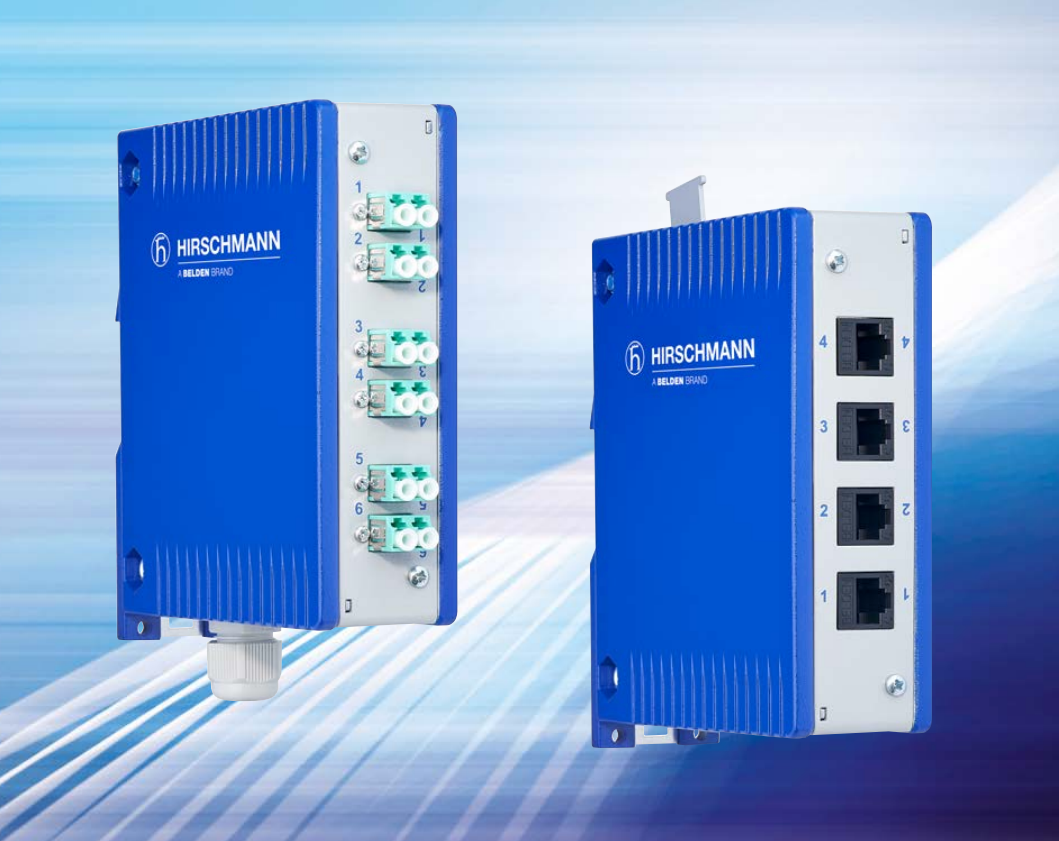
Belden’s Modular Industrial Patch Panel (MIPP) line is specifically engineered to extend IT cabling best practices down into harsh OT control environments. Constructed from high-strength aluminum, MIPPs are compact, heavy-duty physical Layer 1 media panels designed to secure, organize, and protect structured fiber and copper cabling right where it enters the industrial cabinet.
Key features and engineering characteristics of the MIPP family include:
- Configurable widths and modular ports. The MIPP frame offers housings with one- to six-slot configurations, and while the outer chassis width is fixed upon factory ordering, empty module spaces can be populated with blanking plates to accommodate future expansion modules.
- Versatile mounting and reversibility. The MIPP chassis accommodates standard 35mm DIN rails and is optionally available with a secure, heavy-duty wall or panel mounting plate. Modules can also be inverted 180° within the frame to support top or bottom cable entry and orientation flexibility inside of cramped enclosures.
- Broad media support. The platform supports shielded and unshielded RJ45 punch-down jacks, RJ45 couplers, Belden REVConnect connectors, and single-mode or multimode fiber with LC, SC, ST, or pre-connectorized multi-fiber push-on (MPO) assemblies.
- Legacy media conversion. A major advantage of the MIPP is its ability to convert legacy plant infrastructure. For example, facilities with older installed ST or SC fiber runs can terminate those legacy lines into the rear of a single-module MIPP and use short ST-to-LC or SC-to-LC patch cords on the front to connect directly into modern SFP transceiver ports on industrial switches.
- Patching linear to ring topologies. If a facility has multi-strand fiber installed in a linear daisy chain, a modular MIPP patch panel allows engineers to bridge adjacent strands within the cabinet to bypass locations and transform vulnerable linear setups into fault-tolerant media redundancy protocol (MRP) ring architectures.
- Vendor-agnostic infrastructure. The MIPP acts as a Layer 1 physical anchor. It is completely vendor-agnostic regarding connected switches, routers, or PLCs and ensures long-term physical layer stability regardless of active hardware upgrades.
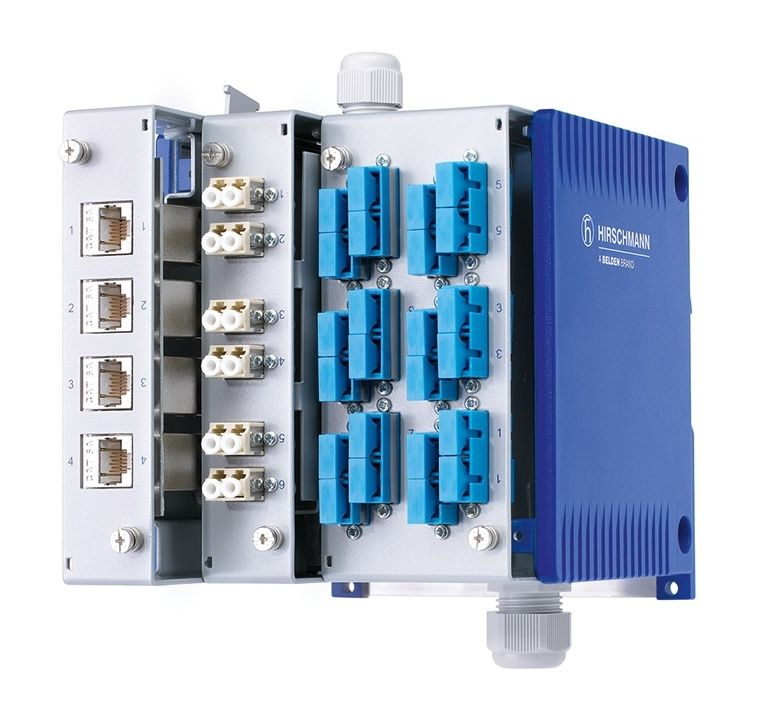
Customers and engineering partners can also design custom module layouts, select between standard pass-through panels and FiberSplice boxes, and verify part build codes using the Belden Configuration Tool. For example, the popular single-mode fiber MIPP/AD/1L9N module represents a standard pass-through MIPP with preinstalled LC adapters. In contrast, the corresponding MIPP/AD/1L9P module (pictured left) designates a MIPP FiberSplice Box equipped with 12 factory-loaded, color-coded 900-micron fiber pigtails, integrated splice tray holders, and internal spooling fingers to manage fiber bend radii during field fusion splicing.
Are there any success stories you’d like to share about Belden’s MIPP modular industrial patch panels?
The extreme physical versatility of the MIPP product line is clearly demonstrated across demanding real-world applications. For instance, a major aerospace launch agency required DIN-rail-mounted patch panels installed directly on an active rocket launch tower. Standard DIN-rail patch panels repeatedly failed or dislodged under the violent shock and intense acoustic vibration of rocket engine ignition. To solve this, Belden provided MIPP units paired with heavy-duty wall and panel mounting plates. By securing the mounting plate directly to the bulkhead structure and locking the MIPP chassis onto both the DIN rail and the plate, the units survived launch conditions without mechanical or signal failure, marking the first patch panels to achieve that milestone at the facility.
Similarly, municipal transportation authorities, such as those managing reversible express toll lanes in Washington, D.C., deploy MIPPs inside stainless steel curbside enclosures along major highways. These roadside cabinets route high-definition video feeds, lane barriers, and dynamic pricing signage data back to central network operations centers. Because roadside hardware and camera poles are highly vulnerable to direct lightning strikes, transportation engineers specified all-single-mode fiber MIPP patch panels to achieve complete optical isolation and safeguard sensitive roadside networking equipment against severe electrical surges.
Is there anything else you’d like RS customers to know about Belden, industrial patch panels, and IT/OT convergence?
It is essential to remember that patch panels reside at Layer 1, the physical layer. Without reliable, properly specified Layer 1 copper and fiber infrastructure, higher-level Layer 2 switching, Layer 3 routing, and enterprise cybersecurity tools simply cannot function.
Belden’s physical media and active networking solutions support mission-critical operations worldwide, ranging from the Florida East Coast Railway and Chicago transit infrastructure to General Motors manufacturing, utility-scale solar and wind farms, battery energy storage systems (BESS), and data center chiller monitoring. Through RS, customers gain access to Belden’s complete ecosystem, including MIPP patch panels, DataTuff Industrial Ethernet cables, Hirschmann switches, Lumberg Automation connectors, and ProSoft gateways.
Improve the functionality and reliability of your rugged industrial networks with modular patch panels from Belden and RS
Belden designs and develops complete connectivity solutions engineered to enable a safer, smarter, and more prosperous future and backed by more than 120 years of experience.
RS offers an extensive selection of Belden connectivity products, including its Hirschmann brand industrial networking solutions, which are tested and proven to deliver high reliability, robust security, and improved efficiency, boost productivity, and protect customers’ investments. Hirschmann brand solutions include managed Ethernet switches and seamlessly integrate with other Belden connectivity products, including Industrial Ethernet cables, connectors, and patch panels. To learn more about Belden’s Modular Industrial Patch Panel (MIPP) line and its Hirschmann brand industrial networking solutions please visit the links embedded here
For more expert insights from Belden, check out the company’s other contributions to the RS Expert Advice Series.
For assistance identifying, procuring, deploying, and maintaining Belden industrial networking solutions designed to securely, reliably, and efficiently transmit data in virtually any industrial environment, please contact your local RS representative at 1.866.433.5722 or reach out to the RS technical support team.