We spoke with Steve Berestecky, Director of Information Technology & Clean Room Air Technologies at ebm-papst, to learn more about the thermal management challenges facing high-density data centers, key fan selection priorities, and high-performance air-moving technologies for server racks.

The global data center market is experiencing explosive growth driven by edge computing, cloud migration, and generative AI. In 2025, global data center capacity totaled 118.92GW and represented a market value of $386.71 billion. These values are projected to grow to more than 240.05GW and $684.39 billion by 2031.
Optimizing the temperature, humidity, and airflow inside of data centers is essential for the stable, efficient operation of server, storage, and network devices. As such, the global data center cooling market is also experiencing massive growth. This market was valued at $18.8 billion in 2025 and is projected to nearly triple in value in less than 10 years, achieving a value of $54.18 billion by 2034.
We spoke with Steve Berestecky, Director of Information Technology & Clean Room Air Technologies at ebm-papst, to learn more. Here, Steve addresses the thermal management challenges facing high-density data centers, key fan selection priorities for server racks, and high-performance air-moving technologies, including ebm-papst DiaForce, RadiCal, AxiTwin, and AxiForce series fans.
Hi Steve. You joined us today to talk about data center cooling — and specifically at the server rack level. So, let’s dive in. What should people know?
The rise of generative AI, machine learning, and high-performance computing (HPC) is driving unprecedented growth in rack power density, and cooling is needed because computers are incredibly inefficient with electricity. Almost all of the electricity fed into server chips is converted directly into heat, and heat negatively impacts component performance and system reliability. In extreme cases, it can even melt silicon components, triggering catastrophic failures and unplanned downtime — the cost for which now averages roughly $9,000 per minute, or $540,000 per hour, but can exceed $5 million per hour for major enterprise outages if you account for all impacts.
A decade ago, standard server racks drew 3–5kW. Today’s AI and HPC racks regularly draw 40–100kW or more. To put that into perspective, a single 100kW rack generates enough thermal energy to heat dozens of single-family homes in the winter, and it’s concentrated in a space about the size of a refrigerator. Without targeted rack-level cooling, this extreme heat creates localized hot spots that facility-level air conditioning alone can’t effectively dissipate.
There are a number of different rack-level cooling solutions to consider when you’re retrofitting an existing data center (a brownfield facility) to better handle higher power densities or designing a new data center (a greenfield facility) from the ground up. These include fan-based forced-air cooling, rear-door heat exchangers (RDHx), direct-to-chip (DTC) liquid cooling, immersion cooling, and passive rack-level air management.
While it’s true that liquid cooling adoption is growing in AI and HPC data centers, fan-based cooling remains the undisputed global standard in data centers for many reasons. These systems require significantly lower component and facility costs and are quicker, easier, and more cost-effective to maintain. They don’t pose any risk of fluid leaks in the vicinity of millions of dollars of high-voltage equipment, and around 90% of the world’s existing data centers were designed for air cooling, so they’re legacy compatible.
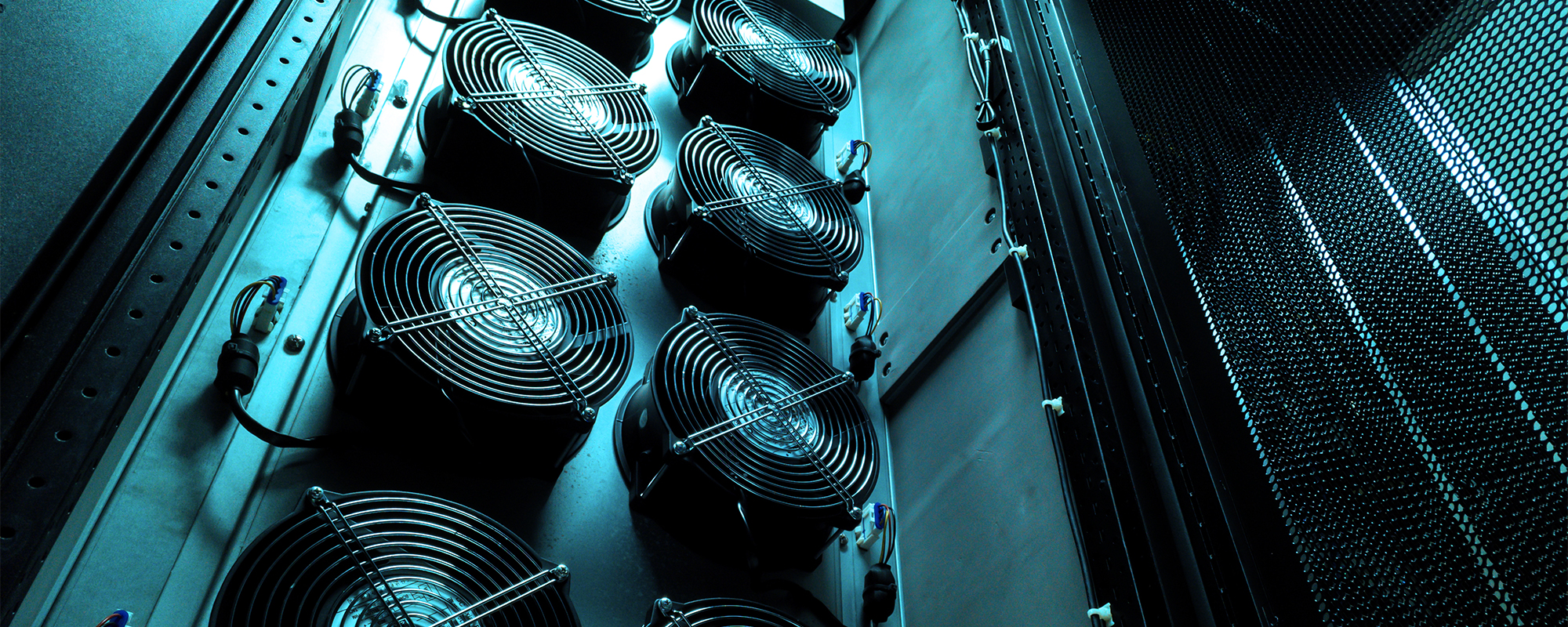
The most common types of air-moving technologies employed in data centers include counter-rotating axial fans, axial and diagonal compact fans, 48V brushless pulse-width modulated (PWM) controlled DC fans, rack fan trays, intelligent exhaust chimney fans, and centrifugal blowers.
What common challenges do people face when it comes to selecting and implementing fans in data center server racks, and do you have any advice for overcoming these challenges?
There are several that immediately come to mind:
- Evaluating the right performance specifications. One of the most common mistakes people make when selecting server rack fans is evaluating them based solely on maximum volumetric airflow, which is measured in cubic feet per minute (CFM). The air in server racks doesn’t flow freely. It encounters intense aerodynamic resistance caused by densely populated PCBs, memory modules, heat sinks, power supplies, and cabling, which shifts the overall system impedance curve higher and requires fans to deliver higher static pressure for effective cooling. So, you’ve also got to evaluate server rack fans for sufficient static pressure capabilities and identify the fan’s desired operating point — the precise airflow required at a given static pressure resistance to maintain effective component-level air velocity — or the air will stall and form hot spots.
Air has a limited physical capacity to remove heat. When moving air through a server chassis, thermal management heavily relies on air velocity, which is measured in linear feet per minute (LFM) rather than overall volumetric airflow (CFM). Once air moving over a chip or component reaches a velocity of roughly 600–800 LFM, increasing that velocity by 10 or even 1,000 times makes virtually no difference in cooling the component itself due to the fundamental laws of physics.
Where increased mass airflow does make a difference is in managing the system’s ambient temperature rise, as described by the mass flow equation (Q = ṁcp ΔT). Higher airflow minimizes the temperature differential (ΔT) between cool intake air and warm exhaust air. However, optimizing chassis thermal performance is a delicate balancing act. During simulation work and prototype testing, thermal engineers should identify the 10–100 most thermally challenging components inside a chassis and design the system to deliver that targeted 600–800 LFM directly to those specific sites. Once that velocity threshold is met, engineers can stop ramping up fan power because moving additional air will simply consume extra energy without providing any added cooling benefit to the electronics.
- Managing parasitic power consumption. This balancing act is also essential for controlling parasitic power consumption. Fan power consumption scales cubically with rotational speed. Doubling a fan’s rotations per minute (RPMs) to increase airflow requires eight times the electrical power. So, overspecifying fans or continuously running them at 100% capacity creates unnecessary energy penalties that negatively impact a data center’s overall power usage effectiveness (PUE).
- Noise and compliance. Another consideration when specifying server rack fans is noise. High-density server racks can produce noise levels exceeding 85–90dBA. Selecting low-noise, aerodynamically optimized fans can reduce or eliminate the need for and cost of acoustic dampening enclosures and is especially important when you’re designing for strict telecommunications environments governed by Networking Equipment-Building System (NEBS) GR-63 standards or European Telecommunications Standards Institute (ETSI) guidelines. Under nominal operating conditions, for instance, NEBS mandates noise levels below 78dB.
- Vibrations and harmonic resonance. Fan rotation also creates structural vibration and harmonic resonance, and as this acoustic and mechanical energy transfers through the chassis, it can diminish solder joint integrity, loosen cable connections, and cause read/write head-disk errors in hard disk drives and optical transceivers. Thermal engineers can mitigate these risks by selecting fans with high-quality ball bearings and minimizing total motor count. For example, replacing dual-stage counter-rotating fans with high-pressure single-stage diagonal fans immediately cuts the motor count and the amount of vibrational energy they transmit in half.
- Failing to design for N+1 redundancy. In redundant fan arrays, the failure of a single fan causes adjacent operating fans to pull hot exhaust air backward through the dead fan module rather than pulling fresh air through the rack intake. To prevent this recirculation, thermal engineers should specify fan assemblies that incorporate hot-swappable modules fitted with mechanical backdraft dampers or louvers that automatically snap shut upon power loss. This enforces proper directional airflow and maintains N+1 fault tolerance, which is critical for NEBS compliance where systems must operate reliably prior to module replacement.
- Poorly calibrated control loops. To ensure smooth thermal management, thermal engineers should prioritize PWM-controlled fans that can directly interface with servers’ baseboard management controllers (BMCs). Uncalibrated control loops often force fans to endlessly cycle between 100% full speed and 20% low speed. This erratic ramping creates fluctuating noise profiles, triggers power spikes on rack power distribution units (PDUs), and places unnecessary mechanical stress on fan bearings. Integrating PWM-controlled fans with server BMCs allows systems to dynamically and gradually scale fan speeds based on real-time temperature sensor feedback to maintain stable airflow, predictable power consumption, and quiet operation.
- Quality. Field fan failures are overwhelmingly bearing-related rather than electronic. For every thousand failures, one or two might be electronic. So, thermal engineers should also prioritize high-quality fans with robust ball bearings, advanced grease formulations, and a high L10 service life (the number of operating hours after which 10% of a deployed fan population may experience a failure) to prevent heat-induced downtime. Depending on ambient operating temperatures, L10 life typically ranges from 70,000 to 120,000 hours, or roughly eight to 14 years.
How is ebm-papst supporting the rapidly growing need for rack-level data center fan cooling?
ebm-papst consistently and heavily invests in R&D at our U.S. and German facilities to further improve the acoustic noise reduction, tonality, aerodynamic efficiency, quality, and L10 service life of our air-cooling technologies, and per our internal design guidelines, every new fan generation must achieve greater environmental sustainability and energy efficiency than its predecessor in the same frame size. Additionally, all ebm-papst products are built to comply with relevant global standards and certifications, including UL, NEBS, ETSI, and OSHA for broad geographic and application suitability.
We also offer a number of fan series optimized for use in data center server racks and infrastructure. These include:
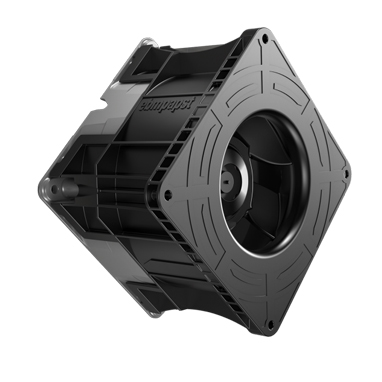
DiaForce diagonal compact fans. These powerful fans combine the high airflow volume of axial fans with the high back-pressure capabilities of centrifugal blowers. This allows them to deliver up to 50% higher air performance than a single-stage axial fan with static pressure matching traditional counter-rotating fans and reduce acoustic noise by 6–12 dB(A) while dramatically improving tonality — or how human ears actually perceive sound. Comparing a counter-rotating fan to an equivalent DiaForce fan side-by-side reveals a night-and-day difference in acoustic comfort rather than just a lower dBA metric on paper. Their unique single-motor diagonal design also reduces the number of fan motors in installations by half compared to dual-motor counter-rotating fans and eliminates a lot of the harmonic vibration energy that causes read/write head-disk errors in hard drive arrays.
While major server OEMs have historically favored counter-rotating architectures, many are now transitioning to DiaForce solutions because their quiet operation and superior tonality give end-product designs a distinct competitive edge, and their industry-standard axial footprints — now available in 40, 80, and 120mm sizes — support quick and easy drop-in installation. As such, they’re increasingly being deployed in data center server chassis and uninterruptible power supply (UPS) applications.
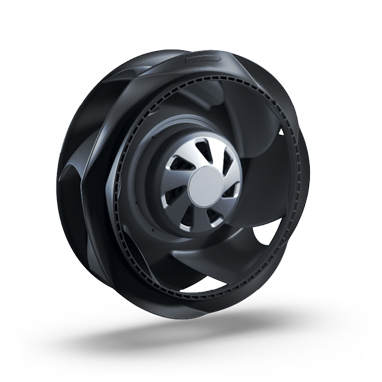
RadiCal series AC and EC centrifugal fans. Ranging from 190mm to 250mm, RadiCal impellers feature aerodynamically shaped blades designed to minimize energy losses, flow separation, aerodynamic turbulence, and acoustic noise while achieving higher aerodynamic efficiency. GreenTech EC versions are available with fixed or variable speed controls and can reduce energy consumption by up to 50% compared to AC alternatives. Thermal engineers commonly deploy RadiCal fans in computer room air conditioners (CRACs), air handling units (AHUs), supply fan grids, rear-door heat exchangers, and in-row rack thermal management systems.
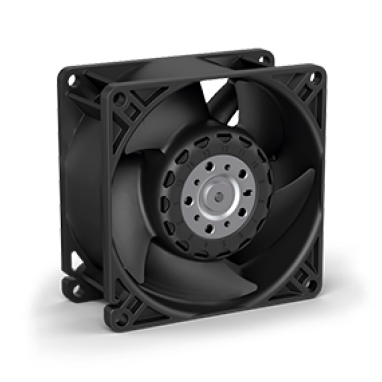
AxiForce series compact axial fans. These modern high-static-pressure air movers feature optimized blade aerodynamics, lower noise profiles, reduced electrical power draw, and robust environmental constructions compared to legacy axial fan series. They’re also available in a wide range of standard compact frame sizes extending from 40–200mm that directly correspond to vertical server rack unit (U) heights spanning 1U server chassis up to 4U and larger rack enclosures, for example, 40mm for 1U, 60 or 80mm for 2U, 92mm for 3U, and 120 and 172 for 4U).
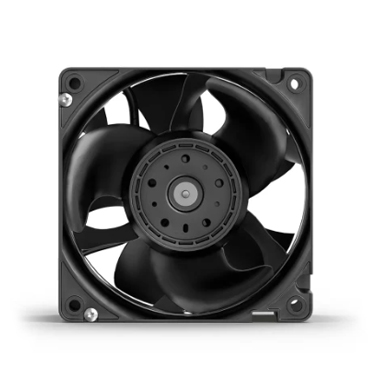
AxiTwin 100mm counter-rotating fans. Built for space-constrained, ultra-high-resistance environments, these counter-rotating fans feature a compact 100mm design optimized to increase static efficiency and minimize noise, along with a patented coupling flange that connects two independently driven motors. This construction allows the rear fan stage to convert residual swirl from the front stage into useful static pressure and airflow. Compared to single-stage units, AxiTwin fans maximize airflow performance within tight spatial limits and are ideally suited for use in highly integrated data center server chassis and UPS applications.
Optimize your high-density rack-level data center cooling architectures with high-performance, low-noise fans from ebm-papst and RS
ebm-papst is a global leader in air-moving technology with an extensive portfolio of more than 20,000 products engineered for efficiency, reliability, and durability. With expertise in motor technology, electronics, digitalization, and aerodynamics, ebm-papst develops sustainable, intelligent, and customized solutions for virtually every industry.
To learn more about ebm-papst air-moving products available through RS — including equipment fans, motorized impellers, and other solutions optimized for data center applications — please visit the links embedded here, check out this interactive data center cooling system graphic, and peruse the company’s other contributions to the RS Expert Advice Series.