Jake Royal, Product and Program Management – Lighting at Banner Engineering, explains how programmable LED indicators do so much more than your average lightbulb, addressing their extensive customization capabilities, applications areas, and common selection and implementation challenges and introducing Banner Engineering’s K50 programmable indicators.

The global LED indicators market currently has an estimated value of $2.4 billion and is expected to grow to $4 billion by 2023, fueled in part by surging demand for smart infrastructure and steady growth in the industrial automation sector.
We spoke to Jake Royal, Product and Program Management – Lighting at Banner Engineering, to learn more. Here, Jake explains how programmable LED indicators do so much more your average lightbulb, addressing their extensive customization capabilities, application areas, and common selection and implementation challenges and solutions and introducing Banner Engineering’s rugged and extremely versatile K50 programmable indicators.
1. Hi Jake. Please introduce yourself and tell us a little about Banner Engineering.
My name is Jake Royal. I am the product and program director for the lighting business unit at Banner Engineering. I studied physics at the University of Minnesota, and I’ve worked in the industrial automation space for around 12 years now. I started at Banner about 10 years ago full-time as an electrical design engineer for our wireless portfolio of products, and I moved into representing Banner’s various commercial business units as a product manager later in my career. Now, I’m the product line director for the lighting business.
Banner is a really exciting company. We started as a family-owned photoelectric sensor company in 1966, and while we’re still a family-owned private business, we now design and develop a vast portfolio of products designed to expand the capabilities of industrial automation equipment — almost all of which build upon and integrate with each other to maximize utility and ROI.
2. You joined us today to talk about programmable LED indicators. So, let’s dive in. What should people know?
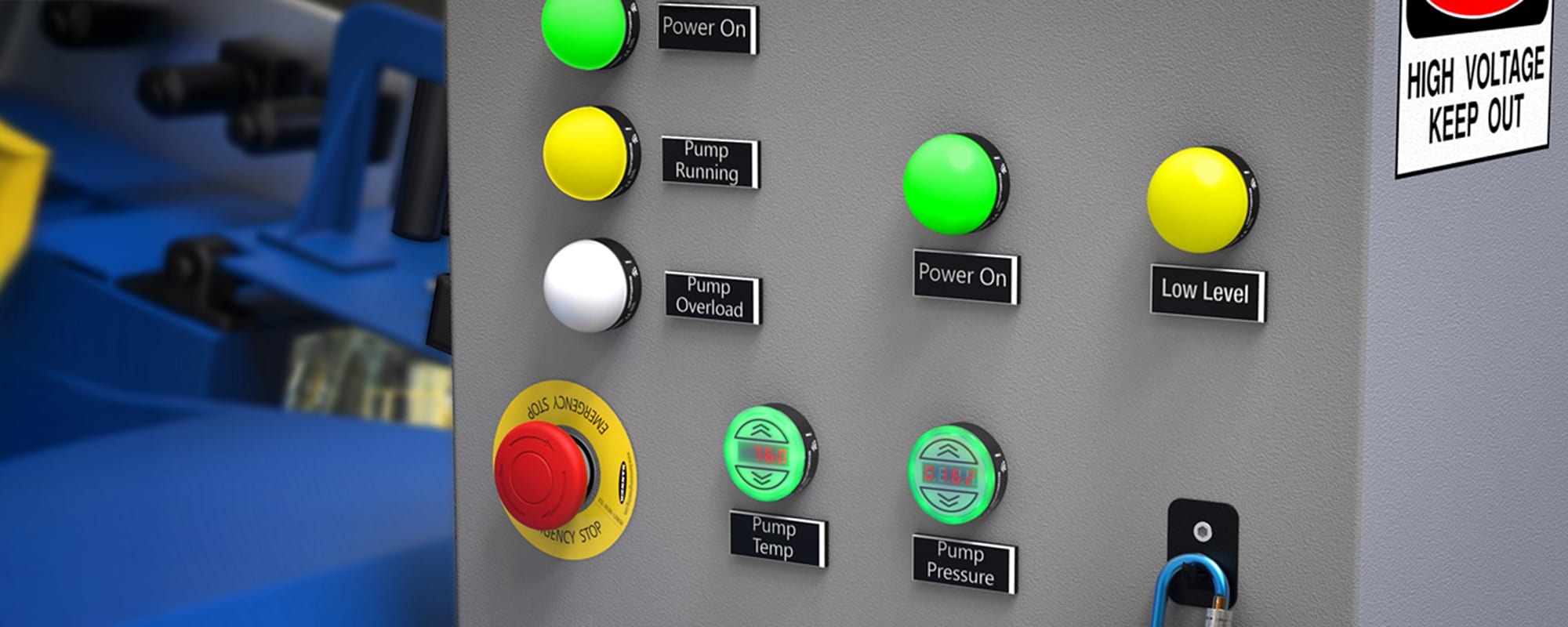
Programmable LED indicators are way more than just light bulbs. Like standard indicators, they allow users to visually and/or audibly communicate real-time machine status using a variety of colors, animations, and sounds that correspond to specific functions on a panel or a control box. Programmable indicators go a step further, though, allowing users to configure custom colors, animations, pin logic, and even audible settings. This gives users many more indication options than standard LED indicators and makes programmable indicators even easier to implement in an even broader range of applications.

Programmable indicators are really used everywhere. They’re used on conveyors in material handling operations, in industrial control panels across industrial market segments, on AGVs and other autonomous vehicles, on airport walkways — you name it. They’re even used under the seats of virtual reality rides at amusement parks.
I think that AGVs and other autonomous machinery and vehicles are some of the more exciting new application technologies because the broad customization capabilities of programmable LED indicators allow the machine builders and robotics and automation OEMs behind them to really like to give these vehicles, bots, and other creations a personality. They allow autonomous technologies like AGVs and robots to alert nearby people about what they’re doing, whether or not it’s safe to approach, whether they’re operating properly or not, and so much more using a wide variety of customizable colors, animations, and sounds.
This is what I mean when I say that programmable indicators are way more than just lightbulbs. Given the plethora of configuration options they offer, you can really customize these products to communicate whatever you want them to, making them easy to integrate into countless different applications in a wide variety of industries.
Programmable indicators typically have full RGB (red-green-blue) capabilities and color mixings and are great for dimming applications and applications that need animations, flash patterns, or audible alerts. That’s really what separates them from standard off-the-shelf LED indicators and lightbulbs.
3. What common challenges do people face when it comes to selecting and implementing programmable indicators, and do you have any advice for overcoming these challenges?
When selecting a programmable indicator, you want to select one that works right out of the box, is easy and intuitive to configure, program, and use, and is capable of accepting any programming or configuration that you require for your application. You also want these devices to be durable and to reliably withstand the hazards of whatever environment they’re placed in. A lot of programmable indicators need to be able to survive harsh industrial or outdoor environments. So, you always want to consider IP ratings to make sure that they’re properly sealed against the hazards of your environment. Otherwise, they could degrade rapidly instead of being useful for years. For example, if you’re selecting a programmable indicator for a washdown environment, you’ll want to seek out options with IP69K ratings, and if you’re selecting one for an FDA-grade hazardous location application, you’ll want to ensure that it’s qualified for that environment and constructed with compliant materials. Most standard programmable LED indicators aren’t. So, environmental considerations are essential when it comes to implementing programmable LED indicators.
You also want to prioritize programmable indicators that deliver flexible capabilities and feature sets, including a wide range of colors, tones, brightnesses, animations, and audible options. Other options you may want to prioritize include touchless or pushbutton activation and advanced features, like the ability to help take measurements.
And, of course, one of the biggest things you’ll want to consider when selecting a programmable indicator — especially for use in industrial environments — is how they’ll communicate with other equipment and devices. Programmable LED indicators with IO-Link communication protocols are especially attractive since IO-Link simplifies wiring, reduces installation complexity and cost, makes diagnostic data more accessible, and enables remote configuration.
4. Please introduce us to Banner’s K50 programmable indicators.
Banner’s K50 programmable indicators are all-purpose panel-mount indicators with a 50mm housing that’s available in a dome or a compact flat-pack form factor with touch or touchless buttons. These models provide highly customizable and unmistakable status indication for machine builders and enable intuitive configuration using our free, proprietary Pro Editor software.

You can control these devices discretely or with common industrial communication protocols, such as Modbus or IO-Link, and you can translate those process signals into actionable feedback, which allows you to add another level to your typical status indication for industrial machinery and equipment. The ability to freely communicate with all of the standard communications protocols that you’ll find in any industrial environment is a really important feature.
K50s have a really robust, durable housing that’s designed to survive the wide range of environments it’s intended for — and even some that it may not be specifically designed for. They’re also available in models specifically designed to ruggedly withstand hazardous environments and satisfy the requirements for FDA-grade installations.
Banner offers really intuitive programming software that you to really put your fingerprints on these devices and make them your own — ideally suited for whatever application you deploy them in. There’s immense room for creativity with a wide range of different colors, tones, dimming options, logic functions, animations, and audible settings. This extensive programmability and customization is really what separates us from the rest of the industry. Nobody else really offers configurable programmable LED indicators like these.
Our newest K50 programmable indicator also features pulse frequency modulation (PFM) and pulse width modulation (PWM) inputs on discrete models, which is ideal for dimming applications. You can pair these with analog sensors that use an analog signal to perform tasks like indicating the status of a frequency drive. You can also program them with an animation either flickers faster or changes color the faster a motor is running.
We also have a K50 programmable LED indicator with what we call a touchless button. This model includes a time-of-flight sensor with an adjustable field, so you can use it for measurements or just use it as a touchless button in pick or place applications.
Additionally, even though K50 indicators offer a great deal of off-the-shelf customization capabilities, we can factory customize them to offer pretty much any color scheme, logic function — anything. And we’re always excited about opportunities to involve customers in the development of their own custom products.
I find it so interesting how many different applications we find these indicators in. They’re widely used in industrial applications, like conveyance, material handling, AGVs, and robotics, but they’re also widely used outside of typical industrial environments. We had a customer that integrated our K50 programmable indicators into a virtual reality ride at an amusement park as part of the virtual visual experience. It’s always exciting to see how creative our customers can be. And we’re always working to build on these current uses and offer new products designed to meet the challenges our customers are facing.
Amplify your indication with programmable LED indicators from Banner Engineering and RS
Banner Engineering is a leading global supplier of industrial automation solutions, including programmable indicators and LED lighting for operator interface and control, as well as non-contact sensors, wireless solutions, and machine safety — all of which are designed to enhance productivity, reduce costs, simplify processes, and improve quality.
RS offers a vast selection of Banner Engineering products, including more than 10,000 lighting and indication solutions, like the K50 programmable indicators Jake discussed here and other panel-mount indicators.
For more information about these solutions, please visit the links embedded here or check out Banner’s K50 product page. For more expert insights from Banner Engineering — on industrial automation topics ranging from digitalization and condition monitoring to sensor and measurement solutions, status displays, and IO-Link devices — click to view their other contributions to the RS Expert Advice Series.
For assistance identifying, procuring, deploying, and maintaining Banner Engineering K50 programmable LED indicators, please contact your local RS representative at 1.866.433.5722 or reach out to the RS technical support team.