
Compressed air systems are notoriously inefficient. Here, RS Product Portfolio Manager Danee Lackey addresses current industry trends and recommendations for improving energy efficiency and introduces smart pneumatic automation and control products that can help do just that.

Compressed air is a safe, reliable energy source that’s been used to power industrial processes since the 1880s. Today, compressed air is commonly used to power automated manufacturing and packaging processes — including transferring, packaging, box making, filling, mixing, cooling, and drying applications — in automotive, food and beverage, pharmaceutical, chemical, and pulp and paper manufacturing facilities and the cleanrooms within them.
And while it’s long been common knowledge that compressed air systems are inherently inefficient — losing at least 80% of their electric input energy to heat and another 5–10% to leaks, artificial demand, and inappropriate use — their reputation as safe, flexible, durable, and low-maintenance frequently made up for that.
Now, though, the sustained influence of Industry 4.0 megatrends, including efficiency and sustainability, has industrial professionals — ranging from maintenance engineers, plant managers, and reliability technicians to buyers in the manufacturing, utilities, and industrial maintenance sectors — reconsidering its employment.
Current recommendations for compressed air systems
The U.S. Department of Energy’s (DOE’s) Better Plants program recommends that new users limit the deployment of compressed air systems to processes that mandate it and otherwise opt for alternatives to improve energy efficiency. Applications that typically require compressed air include:
- Preventing the corrosion of sensitive components in electronics manufacturing processes
- Keeping moisture and contaminants out of pharmaceutical and food and beverage manufacturing processes to prevent bacterial growth, contamination, and spoilage
- Sterilizing medical equipment and enabling oxygen delivery and patient ventilation systems
- Painting, cleaning, and tooling processes for automotive production
- Preventing cement from absorbing moisture and hardening prematurely
- Powering pneumatic tools used in automated manufacturing systems, construction equipment, like jackhammers, nail guns, and riveting guns, and mining equipment, like rock drills, loaders, and ventilation systems
- Starting heavy diesel engines and providing furnace blasts in coal and gas power plants
For users with existing compressed air systems, the DOE’s Better Plants program recommends proper management, which they define as:
- Eliminating inappropriate uses of compressed air (See Table #1)
- Stabilizing system pressure
- Repairing and preventing compressed air leaks
- Decreasing demand-side air usage by reducing the pressure or pursuing alternative technologies
- Using appropriate supply-side technology, including remote monitoring equipment and smart automation and control products designed to identify and either automatically correct or alert operators to correct measured setpoint deviations in system conditions, such as control valves, receiver tanks, dryers, separators, actuators, pressure, temperature, and flow sensors, and FRL units, which combine filter, regulator, and lubricator components

| Inappropriate Uses of Compressed Air | Alternative Solutions |
| Clean up, drying, and process cooling | Low-pressure blowers and electric fans |
| Aspirating and atomizing | Low-pressure blowers |
| Air-operated diaphragm pumps | Electric pumps equipped with regulators |
| Air motors | Electric motors |
| Vacuum generators | Dedicated vacuum pumps |
| Sparging | Blowers and mixers |
| Idle equipment | Air-stop valves installed at the inlet |
| Abandoned equipment | Disconnect the air supply |
The combined effects of these efforts — and especially the implementation of smart automation and control products — can reduce compressed air systems’ energy consumption by 20–50% in addition to reducing maintenance needs and overall costs and improving equipment uptime, reliability, and product quality.
Smart automation and control products for compressed air systems
Pneumatic automation and control products use compressed air and devices including control valves, FRL units, sensors, actuators, and cylinders to automate and control industrial production and packaging processes in automotive, food and beverage, pharmaceutical, chemical, and pulp and paper manufacturing facilities.
Pneumatic control valves regulate the pressure, flow rate, and direction of compressed air to open, close, or throttle valves that control the movement and function of automated industrial equipment. Smart versions use integrated sensors, software, and advanced communication protocols, like IO-Link, to provide real-time monitoring, diagnostics, and remote control capabilities that boost energy efficiency and support predictive maintenance and increased uptime.
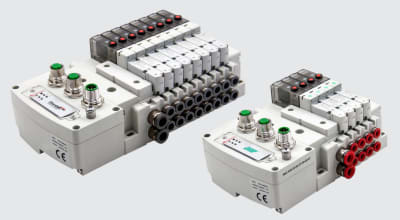
IMI Norgren’s VR Series valve manifolds (Figure 1) feature a simple, plug-in, sub-base design that consolidates direct-ported directional control valves in a simple, compact manifold pre-populated with all the valves, fittings, and silencers needed to enable quicker and easier installation, maintenance, and replacement than series of single valves. These flexible, modular valve manifolds have a robust, lightweight form factor that supports horizontal and vertical direct and DIN-rail mounting and is available in 10mm- and 15mm-wide models with IP40 and IP65 sealing and up to 24 energy-saving, low-power solenoids with LED indicators.
VR Series valve manifolds also offer a wide range of configuration options and support plug-and-play size and functionality expansions and multiple communication protocols — including Multipole, EtherNet/IP, PROFINET, EtherCAT, IO-Link Slave, and CANopen — to ensure compatibility with both new and existing systems. They’re optimized for industrial automation applications, including piloting applications and small actuators, and are rated for flow rates spanning 220–590L/min, up to 101psi (7bar), 12 or 24VDC, operating temperatures extending from -5°C to +50°C, and over 30 million cycles. For more information about the VR Series valve manifolds and other smart pneumatic solutions from IMI Norgren, visit the embedded links.
Air preparation systems are foundational for reliable pneumatic processes in industrial manufacturing applications. FRL units combine three necessary functions — contaminant filtering, pressure regulation, and lubrication — in a single device to prepare compressed air for use in pneumatic systems, protect and extend the longevity of connected tools and equipment, and ensure optimal performance. Smart models with integrated sensors and soft-start valves enable onboard diagnostics, predictive maintenance, improved pressure control, and compliance with stringent cleanroom and pharmaceutical standards.
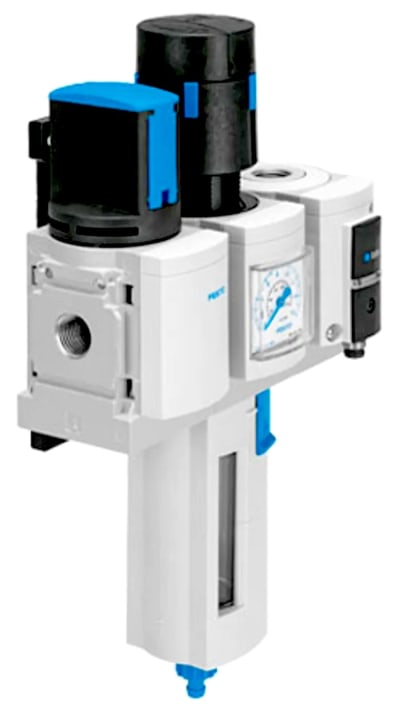
Festo’s MS Series filter regulator lubricators (FRL units) have a highly configurable modular design engineered to ensure reliable filtration and precise pressure regulation in diverse applications, including food and beverage manufacturing and packaging applications and potentially explosive Zone 1, 2, 21, and 22 applications. The series is characterized by high-flow-rate performance with very good control characteristics and low hysteresis, features integrated lockout/tagout functionality for operational safety, three-stage filters, return flow functionality, and exhaust valves, and complies with UL, FDA, and Food Safety Modernization Act (FSMA) guidelines. MS Series FRL units are available in four sizes, equipped with either a mechanical pressure gauge or a pressure sensor with or without a display, offered in specialized variants designed to remove odor and moisture, and proven to improve system efficiency, reduce downtime, and enhance overall productivity. MS series controllers can also be installed as service unit modules, and the series’ blockable product options with continuous compressed air supplies enable the simultaneous control of independent pressure ranges. For more information about MS Series FRL units and other pneumatic MRO solutions from Festo, visit the embedded links.
Flow sensors are crucial automation and control products for implementing predictive maintenance and improving the safety and efficiency of compressed air systems in automated manufacturing and packaging, automotive, and HVAC applications. These sensors measure the rate and volume of air and other fluid media traveling through pipes and convert that data into electrical signals used to analyze and control processes and alert operators to issues, including leaks and flow anomalies.
Gems Sensors & Controls’ FS-380 and FS380P Series Flow Switches are rugged inline flow switches designed to utilize 100µm filtration and reliably resist clogging. They can be used for controlling compressed air in pneumatic processes, as well as water, coolants, and other fluids in process control applications, and when used in compressed air applications should be paired with high-quality air filters to ensure proper operation.

FS-380 Series Flow Switches (the top three in the photo) are compact, high-inline-pressure flow switches with rugged brass or 316 stainless steel housings equipped with one-piece magnetic polyphenylene sulfide (PPS) composite pistons, 316 stainless steel springs, and fluorocarbon O-rings. These single-pole, single-throw (SPST), 20VA switches are normally open at zero flow, available in multiple port sizes, rated for 0.25–2.00GPM flow rates, up to 500 or 1,500psi, and operating temperatures spanning -28°C to +135°C, and ideal for high-pressure industrial cleaning and semiconductor cooling applications that require simplicity and reliability.
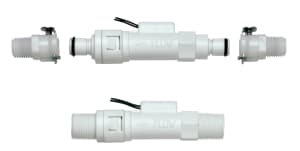
FS-380P Series Flow Switches are industrial-strength plastic inline flow switches that provide the same superior clog-resistant performance as metal FS-380 versions. These SPST, 10VA switches have a glass reinforced polypropylene housing with a simple, dependable ¼” (6mm) quick-disconnect and low-pressure-drop design, PPS composite piston, 316 stainless steel springs, and fluorocarbon O-rings. They’re normally open at zero flow, equipped with fixed set points, available with a host of different snap-on mating adapters to fit most piping requirements, and rated for 0.25 – 2.00GPM flow rates, up to 50 or 125psi, and operating temperatures spanning -18°C to +100°C.
Ideal applications extend throughout the HVAC, semiconductor manufacturing, welding, medical, and beverage industries and include laser heads, welders, power supplies, high-speed spindles, X-ray tubes, semiconductor manufacturing equipment, bearings, gears, presses, rotating equipment, conveyors, machine tools, robotics, beverage processing and dispensing equipment, water purification, X-ray film processing, chemical manufacturing, gas sampling, and distilling.
Pneumatic actuators convert the energy of compressed air into linear or rotary mechanical motion to move equipment components and control valves. They are widely used in industrial automation, construction equipment, machine tool, automotive and food and beverage manufacturing, conveyor, packaging, material handling, aerospace, medical, printing, and textile applications.

SMC’s CP96 pneumatic actuators are designed for versatility, simplicity, reliability, repeatability, energy efficiency, and ease of integration and control in various commercial and industrial applications. These profile tube cylinders are meticulously designed to meet ISO standards, simplify installation, facilitate seamless integration, and maximize uptime. They have a lightweight aluminum construction designed to improve energy efficiency, magnetic pistons designed for easy position sensing and high control accuracy, enclosed tie rods designed to improve mounting accuracy and extend cylinder life, high-precision bushings and piston rods designed to reduce deflection, and durable seals that minimize leakage and maximize longevity. CP96 pneumatic actuators are currently available in six bore sizes spanning 32–125mm with standard stroke ranges extending from 25–800mm and are ideal for use in both clean and harsh environment pneumatic systems that require consistent and robust actuation.
Optimize your compressed air systems with smart process control solutions from RS
Limiting new compressed air system installations to processes that mandate it and following the U.S. DOE’s Better Plants program recommendations for existing compressed air systems — which include implementing smart pneumatic automation and control products, like control valves, air preparation systems, flow sensors, and pneumatic actuators — can reduce inherently inefficient compressed air systems’ energy consumption by 20–50% in addition to reducing maintenance needs and overall costs and improving equipment uptime, reliability, and product quality.
For more information about smart pneumatic automation and control products from RS — including RS PRO brand control valves, FRL units, flow sensors, and pneumatic actuators designed for safe, reliable performance, versatility, convenience, and cost savings without compromise — visit the links embedded here. For more information about pneumatic systems, check out relevant RS Expert Advice content, including:
- “Unlocking the power and versatility of pneumatic actuators,” an interview with Sarah Manual, the Training Manager at IMI
- An interview about process automation valves with Matthew Glicksman, Head of Product Market Management – Process Automation at Festo North America
- “Demystifying directional control valves,” an interview with Bradlee Dittmer, Pneumatic Technical Product Manager at IMI Norgren
- “Smaller, smarter, more talkative pneumatics,” an interview with RS Field Application Engineer Steve Horvath
For assistance identifying, procuring, deploying, and maintaining smart pneumatic automation and control products for compressed air systems, please contact your local RS representative at 1.866.433.5722 or reach out to the RS technical support team.