In this edition of the new Problem? Solved! RS Expert Advice series,Alex Davies, the Senior Director of Solutions Product and Delivery at RS, explains how kitting, bagging, labeling, and custom assembly services help industrial organizations overcome labor shortages and streamline the source-to-build process.
RS serves industrial customers who build and maintain assets and infrastructure throughout the discrete and process manufacturing, facilities and intralogistics, and energy and utilities industries — providing an extensive array of proven product solutions from trusted suppliers as well as a selection of value-added solutions and services designed to solve customers’ pain points. The new “Problem? Solved!” RS Expert Advice series features RS experts addressing common customer challenges they can help you overcome.

For this edition, we spoke to Alex Davies, the Senior Director of Solutions Product and Delivery at RS, about the RS suite of Value-Added Solutions, including kitting, bagging, labeling, and custom assembly services designed to help customers reduce sorting and staging labor and improve picking, maintenance, and assembly workflows.
Hi Alex. Thanks for joining us again to dive deeper into the RS suite of Value-Added Solutions — specifically kitting, bagging, and labeling and custom assembly services. What pain points are these services resolving? And what does utilizing these services look like?
OEMs, machine builders, panel shops, and contract manufacturers make up a large part of our customer base here in North America, and almost all of these businesses have at least some type of manual assembly process that uses humans to build things out of the components we supply. The things they build can comprise any number of parts — spanning single digits to thousands — so their parts lists or bills of materials (BOMs) vary in size, but most tend to include anywhere from a few to a wide variety of suppliers and brands, as well as various specs (e.g., sizes, shapes, colors, capabilities, etc.). So, BOMs can be difficult to manage — especially since parts from different suppliers could have very different lead times.
The procurement professionals at these OEMs, machine builders, panel shops, and contract manufacturers are responsible for ordering lots of differing things from lots of different suppliers, receiving the items, reconciling all the different orders, and putting them where they go, which can require an excessive amount of time and effort.
One challenge that a lot of our production customers are facing is space constraints. A lot of small and medium-sized industrial companies operate out of small and medium-sized buildings and prefer to use their space to house and expand on their assembly capabilities, which is smart but makes holding onto inventory a challenge because it takes up precious space. The inventory these operations tend to stock is typically held in modest storage areas — often cages — that experience a lot of dynamic action: people putting things away wherever they can find the space and then, at some point in the not-too-distant future, finding and picking them, prepping them for use, and delivering them to the assembly teams in the production environment. There’s a lot of duplication of effort.
Imagine you receive 50 parts from 12 suppliers. They’re all different product categories, shapes, and sizes, and you’ve got to find space for each of them in your facility. This requires a lot of walking around and manual labor.
And then there’s the physical production process. To reuse the LEGO® versus off-brand building bricks analogy from my first Problem? Solved! interview, the more individual pieces you have that aren’t clearly organized, grouped, and labeled, the harder and the more protracted production becomes. When BOMs — and especially long, complex BOMs — are delivered un-kitted, bagged, and labeled, like off-brand bricks instead of LEGO, it wastes labor time and delays production.
One of the good things about working with these types of companies is that most — or at least most mid-size ones — have some type of continuous improvement or Kaizen-type mentality in their business. So, they’re really, really receptive to opportunities for improvement and how they can maximize the impact of their assembly teams. Skilled labor continues to be incredibly hard to find and retain in every sector of the industrial market, and that makes these losses disproportionately costly — and solving them super impactful.
In today’s competitive industrial market, organizations strive to be faster to market and leaner than ever. The current geopolitical environment and economic concerns about cost are also adding pressure for small and medium industrial customers to do more with less — but without compromising their commercial position in the market. One of the many ways we help them do this is by simplifying the source-to-build process in much the same way LEGO does — through bagging, kitting, labeling, and even custom assembly.
From a custom order solutions perspective, we do a number of different things that fall into one of the following three categories:
- Kitting, bagging, and labeling. Kitting is a preparation process that involves grouping several to many individual products with individual SKUs together in a single package that a customer can order and manage throughout the process as a single SKU. And while kitting may sound simple, using thoughtfully organized and clearly labeled collections of parts in your assembly process makes it undeniably smoother and faster than starting with unorganized piles of disparate parts. Additionally, sometimes the multiples we sell things in aren’t compatible with customers’ production processes. So, simply re-bagging and labeling these parts can be extremely advantageous. Plus, if customers are open to brand consolidation, using RS kitting services to consolidate several products from a single supplier as a single SKU can help them leverage economies of scale for better pricing and reduce costs.
Pre-labeling things like terminal blocks and wires can also be super helpful for customers in terms of labor and cost savings.
Things like cutting lengths of DIN rail can fall into this category as well — especially if we’re kitting the rail with the components destined to fasten to it.
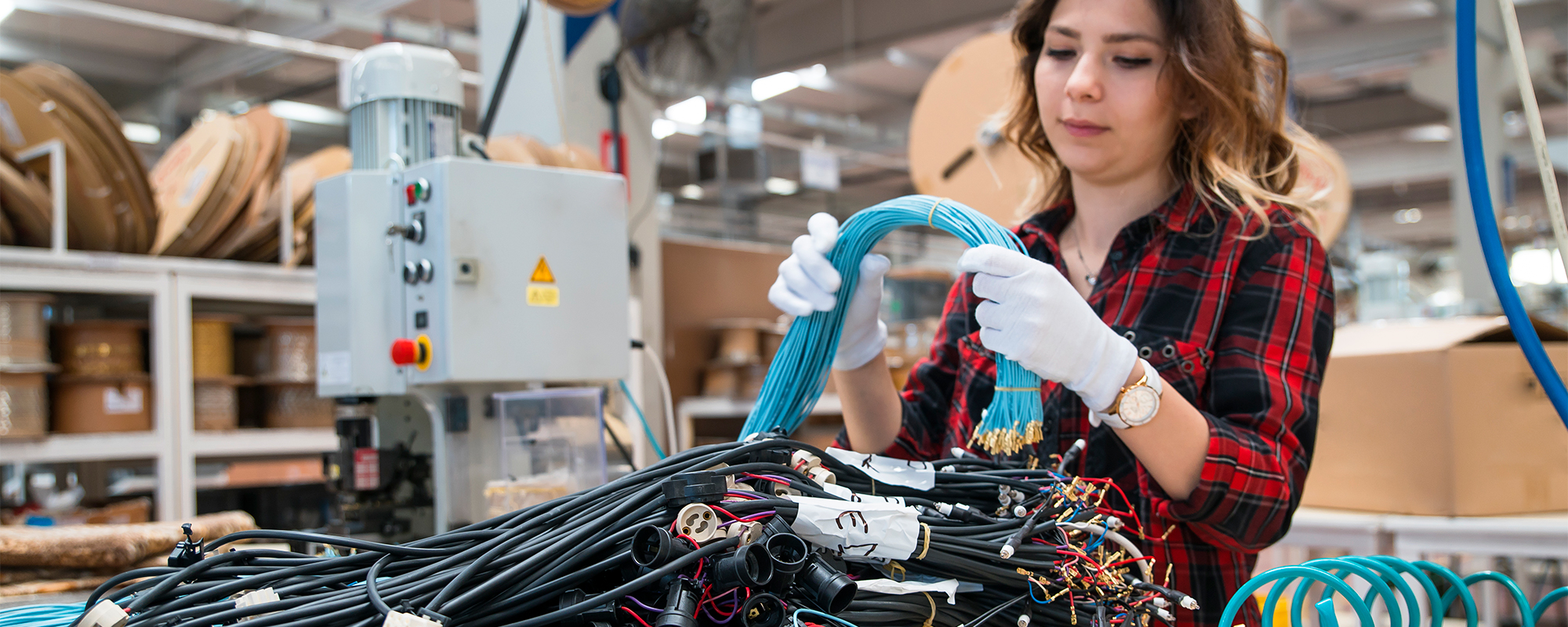
- Component assembly. This process involves assembling a few things that belong together to further mitigate the amount of time customers spend preparing parts for production. This could include crimping a wire we’ve cut to a specific length, pushing a pneumatic fitting onto the end of a tube, or clipping a filter and a regulator together. It’s really simple stuff, but it consolidates another few to several parts down into a single SKU and further simplifies customers’ supply chain and production processes, which helps them maximize labor resources and, ultimately, save time and money.
We do a quite a lot of that stuff in-house. We have a dedicated work cell that’s de-zoned within the Fort Worth distribution center. And we’ve got a team of people that spend most of their days kitting, bagging, tagging, and assembling small components just to make life easier for customers.
- More complex subassembly. The principle behind this is exactly the same as component assembly; it just involves more complex production assistance than terminating a wire. We do some of this in house, and what we don’t do in-house is carried out by a wide and growing network of rigorously vetted supply chain partners with a variety of proven capabilities and established presences and trusted reputations in our customers’ communities.
We look at their quality processes and make sure that we’re aligned, and we provide them with guidance around how we want them to operate. We then provide them with a BOM list and all the materials they’ll need, and then they’ll build the assembly on our behalf and then ship it to the customer.
Like all of the services in our Value-Added Solutions portfolio, our kitting, bagging, labeling, and custom assembly services are specifically designed to resolve customer pain points, reduce friction, streamline procurement processes, and help customers get to market faster and do more with less.
Optimize your production workflows with the RS suite of Value-Added Solutions
If reducing sorting and staging labor, simplifying BOM management, maximizing your labor resources, improving your assembly workflows, lowering your production costs, and getting to market faster sounds advantageous, reach out to your local RS representative at 1.866.433.5722 or contact the RS Value-Added Solutions Team to learn more about our kitting, bagging, labeling, and custom assembly services.
RS offers a variety of proven capabilities designed to reduce friction in your facility and help you succeed in today’s increasingly challenging and competitive market — ranging from simple but impactful kitting, bagging, and labeling services to complex subassembly services. Our expert business development managers are happy to talk to you, learn your business, and identify the custom order solutions sure to help you do more with less and provide you with maximum value.
To learn more about Alex Davies and his keen insights into RS Value-Added Solutions, check out his recent RS Experts Behind the Advice interview, “When expertise meets authenticity, industrial customers win,” and “Problem? Solved! Streamlining procurement.”